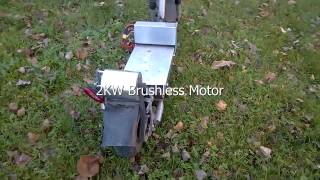
2 KW Offroad E-Scooter
This project came about several years before e-scooters became as popular as they are today. I really enjoyed riding scooters and simply wanted to get around more easily and quickly, especially off-road, where I really enjoyed riding. So I set out to find a way to convert my off-road scooter into an e-scooter.
The first attempt
In the first stage, I used a 300W DC industrial motor with NiMh batteries, which allowed me to reach speeds of around 25-30 km/h for the first time. Unfortunately, this didn't last very long, as the motor became slightly overloaded because the torque didn't match the motor despite the high gear ratio, and I couldn't increase the gear ratio any further.
With the first benchmark of how much power is needed, how much torque is required and the resulting power to be able to drive at a minimum of 30 km/h continuously, I set out to find a motor with at least 500W and found what I was looking for after a short search.
The footboard of the scooter was made from aluminium sheet metal welded into a box to house the NiMh batteries. An aluminium sheet was welded to the aluminium base plate, which had a recess for the motor and held it in place with clamps. The motor was so powerful that it bent the aluminium plate, so I had to come up with a new solution. The industrial NiMh batteries I was using were not designed for the continuous power consumption of the motor, so they overheated and even started to explode and leak.
Werbung
Battery upgrade
After a long search for suitable batteries and unable to find any inexpensive NiMh batteries that met my performance requirements and also my space and weight requirements, I decided to use lithium polymer batteries from model making.
I already had experience with these batteries and know how dangerous they can be and how difficult it is to install them safely in a vehicle so that they can be properly balanced. There are two options: either cables are connected to each cell of the battery with the charger and the charger takes care of balancing the cells, or you have electronics built into the batteries that ensure that all batteries have the same voltage.
After a long search, I couldn't find any electronics that were designed for the desired number of cells and charging/discharging capacity, so I had to leave access to the balancer plug for each battery.
I also had the problem that I couldn't find a charger that could charge both battery packs at the same time, so I had to charge the batteries one after the other.