Adapterplate for my Lumix FZ1000
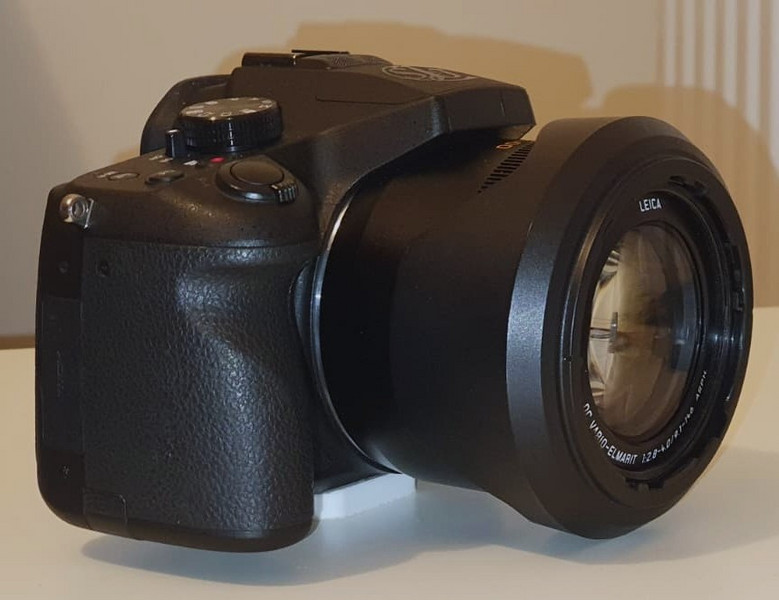
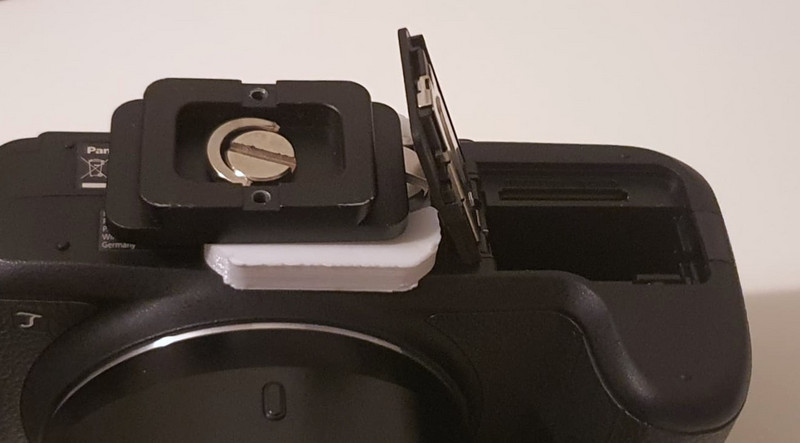
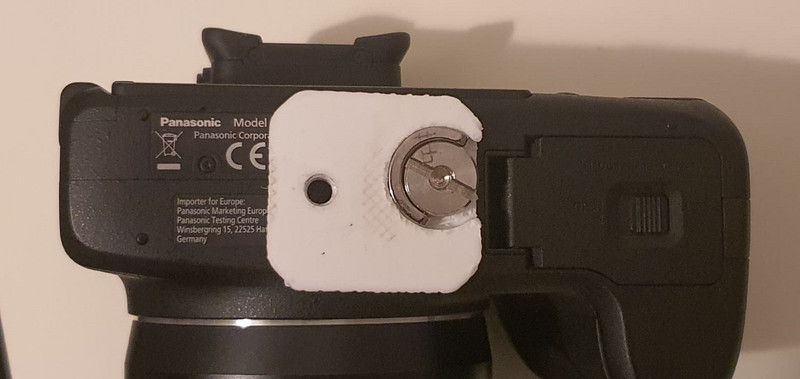
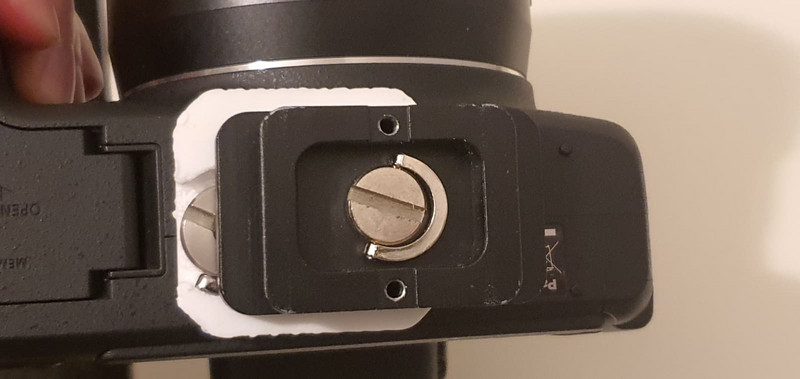
Unfortunately, the Panasonic Lumix FZ1000 does not have the thread for the quick-release plate centered on the lens, but rather closer to the battery compartment. This means that you can no longer change batteries once a quick-release plate is mounted, which can be very annoying. So, I decided, as one of my first 3D printing projects, to design a plate that allows the quick-release plate to be mounted centered on the lens, enabling constant access to the battery compartment.
The Challenge
The adapter plate was quickly drawn in Fusion, but the first hurdle was figuring out which thread this camera thread actually is. The second hurdle was then finding it in Fusion, because here you need to know the exact designation of the thread, not just 1/4", but a UNC 1/4" 20. After a longer internet search, that was finally done, so off we went to print the first prototype.
The first prototype fit perfectly right away, and I was so happy to finally be able to leave the quick-release plate on during battery swaps.
Unfortunately, a second problem then arose: I couldn’t tighten the adapter plate enough to prevent it from eventually starting to rotate and become loose. The first solution was to use screws that have a foldable handle so I could tighten them again and again, but that seemed too risky to me, so I looked for another solution.
Unfortunately, it then turned out that the edge was a bit too small, and over time, the 3D print—yes, this project was one of my first, and the quality of the prints was not very good, especially the layer adhesion with ABS, which was very poor since I was printing without an enclosure heater.
But I decided to print the final version in PETG, and lo and behold, even the layer adhesion is significantly better with PETG, and the thread wears much slower than with ABS. The only downside is that PETG is a bit more flexible than ABS, and the adapter plate is slightly more flexible than I would like.
Learnings and what I would do differently now
Nowadays, I would carry out this project with PC or Nylon-CF and obtain a plastic part that would be more durable, cheaper, and lighter than aluminum in this area of application.
For the gear, I would make it out of pure nylon to ensure longevity.