
The Core by Micro & Developed by Stefan J. Trucker
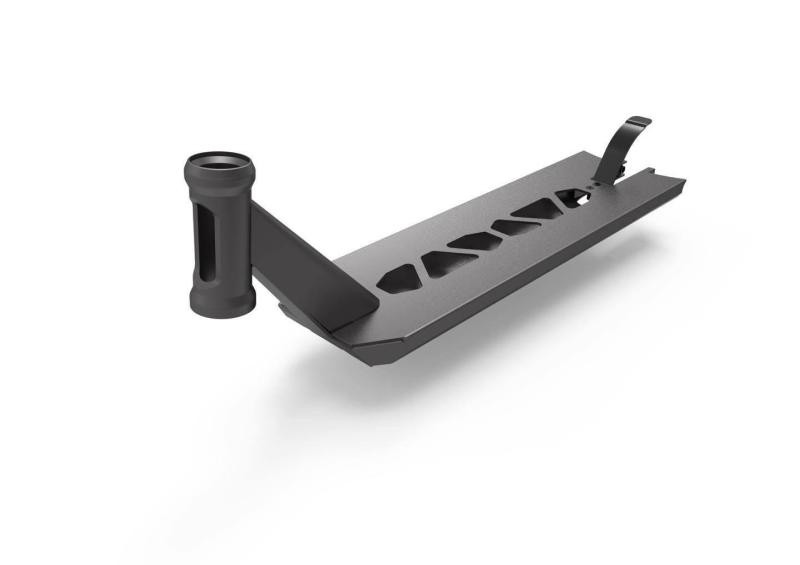
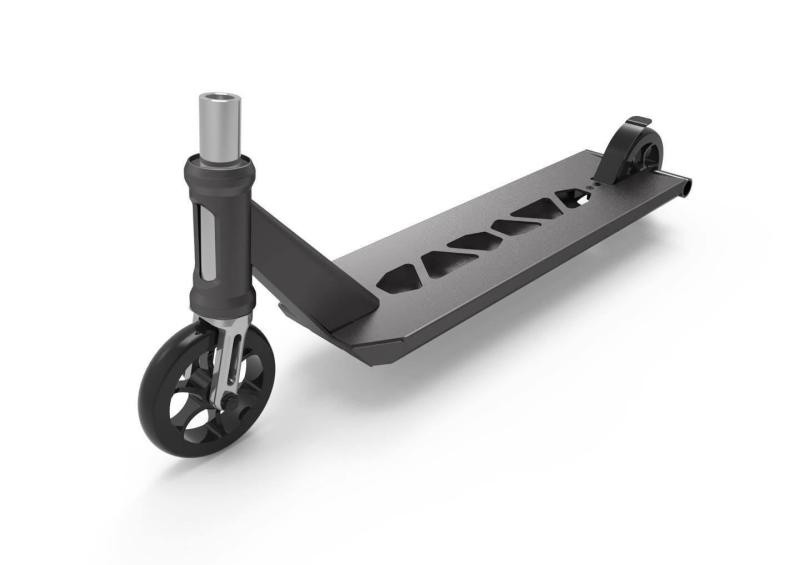
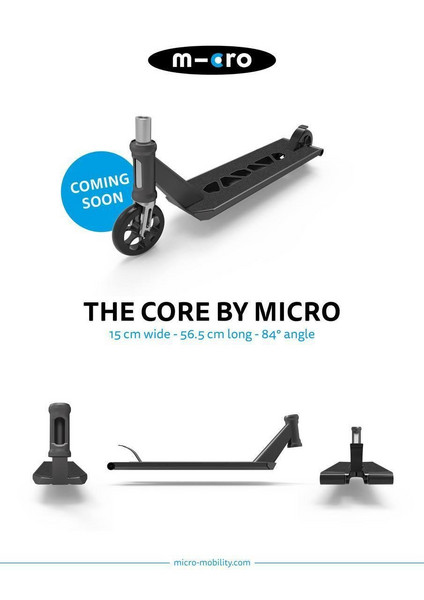
Since the design of the BMX Style Fork for Micro I developed was very well received, and the S5 Scooters Hybrid Deck also met with great approval, I was asked to optimize the new deck for the market, taking the existing components into account – both in terms of weight and aesthetic design, where my good eye is particularly needed.
Goal
- Lightweight
- Compatible with all systems
- Very stable
- Inexpensive to produce
- Compatible with the new 120 mm Wheels
- Consider and reuse existing parts
- The deck width should be 120 mm and ideally still allow for cornering
- The deck should have holes; firstly for weight optimization and secondly for aesthetic reasons
- Decks with integrated pegs that are easy to replace, even if the deck is already bent, and can also be used separately
The Challenge
Holes in the Footboard
The biggest challenge was designing the holes in the footboard, as Micro had very specific requirements, and I only wanted to design holes that would never endanger a rider. Originally, Micro wanted a large hole on the underside of the footboard, which poses a significant risk to the rider. A hole could cause the rider to run over or jump on something and get caught on it, causing the scooter to stop and throw the rider off. My deciding factor was ultimately the emphasis on stability. With my neck-welded design, the middle base plate can be made very thin, and a thin connecting plate on the left and right sides adds significantly more stability to the deck.
Micro, however, wanted a more organic design here, one with slightly larger holes but still needing to be strong. And this was very difficult: striking a balance between large, but not too large, organic, yet uniformly sized holes, so that no pressure hotspots would form when the deck was under load.
At first, I thought it was impossible, but then I approached the whole thing step by step. First, I looked for an organic shape that met the requirements. Then I considered how I could arrange it so that it was evenly distributed. After trying a few things back and forth, I realized that I could only work with reflections, because otherwise, it would never be possible to achieve an even distribution. Now I just had to figure out where to place my axis of symmetry and how to arrange the pattern within the area.
So, to begin with, I drew a straight line down the middle and then started designing the pattern in the foreground. I quickly liked the first draft and mirrored it along the center line. Then I didn't like it at all anymore; it lost all its organic feel. Then it dawned on me: I had to mirror it twice, and immediately I was completely satisfied with the result. I was also very tired, as it was now the middle of the night, so I decided to send it to Micro right away, hoping they would like it too, and went to bed.
Early the next morning, I received an email saying they were absolutely thrilled with the design and didn't want to change anything.